MDF co-marketing that doesn’t die in a spreadsheet

The call was short and ugly.
A channel manager is staring at a £38,740 MDF claim: “LinkedIn + webinar + email blast.” The partner’s proud. The vendor’s finance team is not. Salesforce shows zero influenced opportunities. The partner says the leads went to their BDR Slack. The vendor says if it isn’t in the CRM, it didn’t happen. The partner quietly stops pushing the vendor’s product the following quarter.
That scene is why MDF co-marketing gets treated like a cost centre. Not because co-marketing is broken. Because the way most MDF programmes are run makes ROI unprovable, and then everyone acts surprised when nobody renews.
Focus sits in the middle of this problem: vendor-side rules, partner-side reality. That two-sided position is the whole point of what we do.
Why Do Most MDF Co-Marketing Programmes Fail to Show ROI?
Most MDF programmes fail for the same reason: the campaign and the attribution model don’t match. Partners run activity. Vendors expect traceable revenue. Both have valid incentives. The gap between them is where MDF goes to die.
Industry data shows that around 60% of available MDF goes unspent each year, and a significant portion of what is spent cannot be attributed to measurable outcomes. (Source: Ansira, 2023.) The problem isn’t partner disengagement. It’s a structural mismatch between how activity is funded and how results are measured.
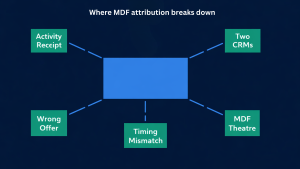
Five failure modes appear consistently across programmes.
The activity receipt problem. Partners submit invoices and screenshots. Vendors approve based on compliance, not outcomes. MDF becomes a rebate programme with marketing cosplay. You pay out. Nobody learns. Next quarter repeats.
The two CRMs problem. The partner’s pipeline lives in Autotask, ConnectWise, or HubSpot. The vendor’s lives in Salesforce. Data doesn’t flow. The vendor cannot prove ROI, so budgets get cut. The partner cannot prove contribution, so they stop bothering. Everyone loses.
The wrong offer problem. MDF gets spent on content and webinars that sound credible but don’t move deals. The result is leads that don’t match the partner’s installed base, and a partner sales team that refuses to follow up because it’s “vendor stuff.”
The timing mismatch problem. Vendors want results inside a quarter. Partners sell services and bundles with longer cycles. MDF gets forced into short-term lead generation plays instead of the fewer activities that actually build repeatable pipeline.
The MDF theatre problem. A partner will always say they’ll run a webinar. A vendor will always approve it. Both know the probability is low. Everyone does it anyway because it is easy to tick the box. The result is wasted budget and a slowly rotting partner relationship.
Should MDF Be Treated as Demand Generation?
No. That’s the core misunderstanding that drives most of the failure.
Most MDF campaigns don’t fail because partners are disengaged or vendors are stingy. They fail because MDF gets treated as a miniature direct demand generation engine, which it isn’t built to be.
MDF is better understood as one of two things: a capability investment that helps the partner learn how to sell the vendor’s solution repeatedly, or a pipeline acceleration tool that helps the partner close what is already warm. When a programme tries to do both simultaneously, it achieves neither.
If the question is why most MDF campaigns fail to show ROI, the answer in one line is this: MDF is allocated to activities that look measurable, not activities that are actually causal.
Four Approaches That Work
Below are four approaches that produce outcomes surviving both finance scrutiny and partner reality. Each has a deliberate trade-off. The choice between them depends on what the programme needs to achieve.
Approach 1: Proof-of-Work MDF
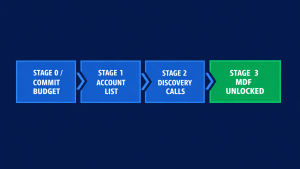
Rule: MDF is unlocked in stages only after the partner completes pre-work that proves intent and readiness.
A practical stage gate runs as follows. Stage 0: the partner commits a portion of their own spend and assigns a named owner. Stage 1: the partner submits a target account list with firmographics and service fit confirmed. Stage 2: the partner runs outreach and books a defined number of discovery calls. Stage 3: MDF reimburses campaign costs up to the agreed ceiling.
This approach prevents MDF being used as free marketing. It forces the partner to demonstrate they can execute the sales motion required to convert demand before the vendor funds it.
What you gain: far less waste, far fewer zombie claims, and a clean internal story for finance. What you sacrifice: volume. Some partners will complain that MDF has been made too hard to access. Those are usually the partners who would have wasted it.
Approach 2: Offer-First MDF
Rule: MDF funds an offer, not an activity. No campaign is approved until the offer is sharp enough to sell in one sentence.
Offer structures that convert in MSP markets include a fixed-scope assessment with a clear deliverable and price, a migration package with a defined system boundary and success criteria, a compliance readiness sprint with timeboxed and tangible outputs, and a bundle offer where the vendor and MSP service are wrapped together and priced as a product.
Most MDF activity fails because it is abstract. MSP buyers do not buy abstracts. What you gain: higher conversion and better alignment between partner sales and marketing activity. What you sacrifice: brand polish. Offer-first campaigns can look less enterprise. That is an acceptable trade-off if the goal is revenue.
Approach 3: The Attribution Ladder
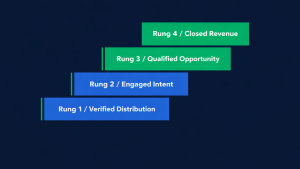
Rule: attribution is defined in rungs, with different payout rates at each rung. No single metric carries the entire judgement.
A practical ladder runs from Rung 1, verified distribution where the partner proves the content was actually pushed, through Rung 2, engaged intent where a meeting was booked or an assessment requested, to Rung 3, a qualified opportunity fitting ICP, budget, and timeline, and Rung 4, closed revenue.
MDF payout logic follows the ladder: a smaller percentage at Rungs 1 and 2, a higher percentage at Rung 3, and the highest percentage at Rung 4.
This approach stops the monthly argument where marketing points to clicks and sales demands revenue. It acknowledges the full journey without misrepresenting any part of it. What you gain: fewer internal disputes, clearer learning, and more campaigns that can be scaled. What you sacrifice: simplicity. Finance will want one number. The programme needs to be defended with data at every rung.
Approach 4: Warm Pipeline Only
Rule: MDF is used exclusively to convert existing partner pipeline that already includes the vendor, not to create new demand.
The sprint structure is tight and measurable. The partner identifies a defined set of accounts already discussing the relevant problem. The vendor provides sales engineering hours, enablement, and deal support. MDF funds only conversion assets: customer proof, a security pack, a workshop, or a proof of concept.
Most co-marketing sits too far upstream. If the goal is ROI inside a quarter, funding top-of-funnel activity is not the answer. What you gain: faster wins, a cleaner ROI story, and stronger partner trust from being seen as a closing resource. What you sacrifice: future pipeline creation. This is a harvest approach, not a planting one.
The MDF Operating System: Building the Closed Loop
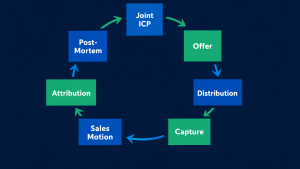
Most MDF programmes have rules. Few have an operating system. The closed loop is what makes a programme scale rather than stall.
The loop that holds up in practice runs through seven components. A joint ICP where the vendor and MSP agree on what a good prospect looks like. A sellable offer that can be described in one line. A distribution plan owned by named individuals, not a generic marketing function. A defined capture process covering where leads go, how they are tagged, who follows up, and by when. A sales motion with the first call script and the next step defined before launch. An attribution ladder agreed before the campaign runs, not after it ends. A post-mortem within ten business days that is specific and documented, not a diplomatic debrief.
If any of those components are missing, the programme does not have MDF co-marketing. It has shared hope.
What the 20% Who Succeed Do Differently
The vendors who consistently produce attributable MDF outcomes share a set of behaviours that are uncomfortable to implement and straightforward to describe.
They say no to claims that don’t have a clean capture path. They treat partners as adults by making MDF something earned rather than allocated. They use co-branded webinars only when a real offer and a real follow-up engine are in place, not as a default activity. They run fewer campaigns, but each one carries a defined learning goal and a repeat plan. They fund execution rather than just reimbursement, because a partner who cannot execute turns MDF into a donation.
None of this is complex. Most of it is uncomfortable. The discomfort is the point.
MDF Either Proves Itself or It Doesn’t
The vendors who close the attribution gap are not running smarter campaigns. They are running fewer, better-designed ones, with the infrastructure to prove what happened.
MDF is not a cost centre by nature. It becomes one when the operating system isn’t there.

Where Is Your MDF Programme Losing Ground?
Focus works with technology vendors to audit MDF programme design and rebuild the attribution infrastructure that connects spend to outcomes. If the ROI conversation is getting harder to have internally, the problem is rarely the budget.